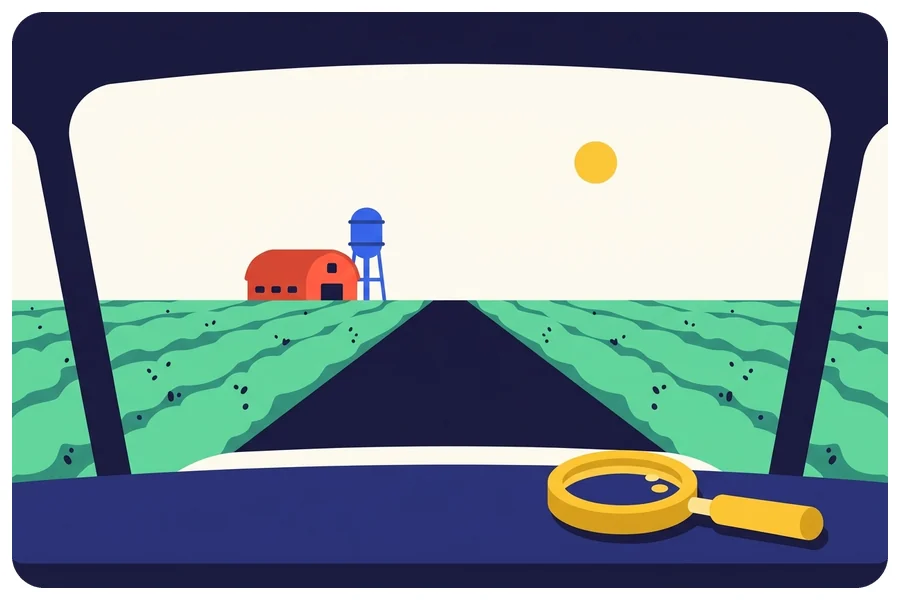
I Spy is a guessing game: one player secretly picks something everyone can see and gives a clue (“I spy with my little eye something that is green”), and the others guess until someone names it. The winner spies next. It’s the first car game most kids learn, and it works from about age 3.
Why I Spy breaks in a car, and the fix
At home, the red cup stays on the table. In a car, the red barn is gone in four seconds, and a round of I Spy collapses into “it was back there.” The fix is one rule we use every time:
The object has to stay visible for the whole round. That means one of two places:
- Inside the car. Seat belts, the water bottle, Dad’s sunglasses, the stuffed rabbit.
- Far ahead or high up. A mountain, a water tower, the sky, the road itself, a billboard two miles out, the car you’ve been behind for ten minutes.
Say the zone with the clue: “I spy something inside the car that is yellow.” Guessers now know where to look, and the round ends with an answer instead of a dispute.
The rules
- The spy picks an object and gives a clue: color for young kids, first letter for readers.
- Guessers take turns naming things. The spy answers only yes or no.
- After ten wrong guesses, the spy gives a second clue (“it’s bigger than a car”).
- The correct guesser becomes the next spy. If nobody gets it in 20 guesses, the spy reveals it and goes again.
Versions by age
Toddlers (3–4)
Colors only, inside the car only. Point to help: “I spy something red, and it’s near your feet.” Let the toddler be the spy early. They will pick something and forget what it was; guess generously.
Kids (5–8)
First-letter clues, plus the outside zone. Add “I hear with my little ear” rounds: the spy picks a sound (the turn signal, the air vent, a truck passing), and everyone else closes their eyes and guesses.
Older kids (9–12)
Harder clues: a shape (“something shaped like a triangle”), a material (“made of rubber”), or two clues at once (“starts with T, and it’s white”). They’ll say I Spy is for babies. It stops being babyish once the clue is “something older than Grandma.” For guess-the-thing games they won’t outgrow, move up to 20 Questions.
Teens and adults
Grown-ups mostly play I Spy for the little ones, so give yourselves a handicap: adults may only spy things more than a mile away, and must answer questions in a silly voice. A teen who agrees to be the spy for a toddler buys the parents twenty quiet minutes.
Scoring, if your kids need a winner
I Spy has no points by default, which is fine for toddlers. For competitive kids, the guesser earns points by how early they got it: 3 points in the first five guesses, 2 points by ten, 1 point after that. The spy earns 2 points if nobody guesses it at all, which rewards clever picks and discourages impossible ones.
Driver-safe version
The driver can’t search the car or scan the roadside, so the driver only plays the answering role. The driver is always the spy and picks something already in their line of sight: the road ahead, a sign they’re approaching, the sky, a truck in the next lane. Then they answer yes or no while the passengers guess. It keeps the driver in the game without asking them to look anywhere new.
Tips for long drives
- Keep rounds short. A round that passes three minutes loses the little ones; give a bonus clue early.
- Rotate the spy so the loudest kid doesn’t hold the turn all afternoon.
- At night, switch entirely to “I hear” rounds and inside-the-car objects under the dome light.
When it gets boring
I Spy wears out faster than most games, usually after 15 to 20 minutes.
Stop while it’s still fun and come back after the next stop. Before you drop it, try one round of “I spy something that isn’t here”: the spy names something they’re thinking of from home, and everyone else has to guess it from clues. That’s the bridge to 20 Questions. For a game with a card in hand, try road trip bingo.