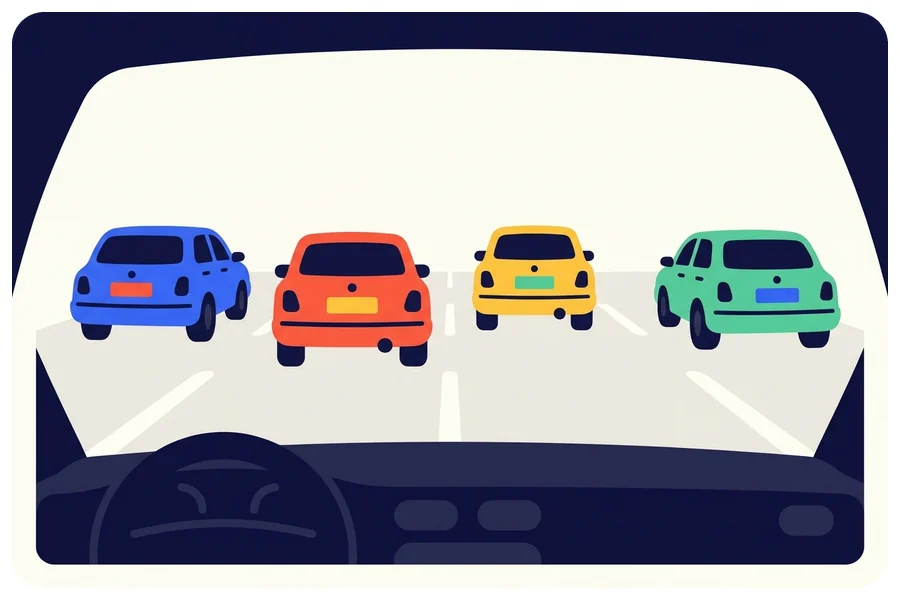
The license plate game is a hunt for out-of-state plates: every time someone spots a plate from a state or province the car hasn’t found yet, they call it out and claim it. It runs in the background of the whole drive, which is why it survives eight-hour days better than any game that needs full attention.
The classic rules
- Before you leave, agree on the list. The standard one is the 50 states plus Washington, DC. Add the 13 Canadian provinces and territories if you drive near the border.
- When you see a plate from a new state, say it out loud. First voice wins it.
- One passenger keeps the list. A notes app works; a paper map of the US that kids shade in works better, because they can see the gaps.
- The game ends when you arrive, or it carries over to the drive home.
Settle two house rules up front, since they cause most of the arguments: do parked cars count, and does a plate have to be readable or is the design enough? Most families say yes to both.
Scoring that stays fair
Plain “most states wins” favors whoever sits on the passenger side facing traffic. Three fixes:
- Team car. Everyone works toward one list. Best for mixed ages; a 5-year-old contributes as much as a teenager.
- Distance points. Far-away plates are worth more. Under 300 miles from your home state scores 1, under 800 scores 2, under 1,500 scores 3, and anything farther scores 5. Hawaii and Alaska are worth 10 flat, and a Canadian plate earns a bonus point. The license plate tracker does this math for you.
Versions by age
Toddlers (2–4)
Skip states. Play “find a plate with the letter in your name” or “find a red plate.” Toddlers can’t read Wyoming, but they can spot a cowboy on a horse.
Kids (5–9)
The classic game with a coloring map. Let them shade each state as it’s found. A kid who hasn’t found one in an hour gets the next plate automatically.
Tweens and teens
Plate math: add the digits on a plate, and the closest to 21 wins the round. Or plate acronyms: turn the three letters into a phrase (“KMZ: Kangaroos Make Zucchini bread”). Funniest phrase, judged by the driver, wins.
Adults
Play the long game. Keep one list for the whole year, across every trip, and see how close the family gets to 51.
Driver-safe version
Reading plates means reading moving text, so the driver shouldn’t hunt for them. Give the driver a different job: judge. The driver rules on disputed calls, keeps the plate-acronym scores, and announces the running total at every stop. They stay in the game with their eyes on the road.
Tips for long drives
- Rest stops, gas stations and hotel parking lots are where you find the far-away plates. Do a two-minute lap before getting back in.
- Interstates beat back roads for variety. Tourist corridors (I-95, I-80, I-40) bring plates from everywhere.
- Summer brings more out-of-state traffic than winter. On a February drive, a list of 20 is a good result.
When it gets boring
It will, usually around hour three, when every new plate is from the state next door.
Switch modes instead of quitting. Move to plate acronyms for twenty minutes, or give everyone a secret target state and see who finds theirs first. The main list keeps going in the background.
If you want a game that needs less waiting, road trip bingo gives every player a card of things to spot, and the alphabet game uses the same plates for a faster race.