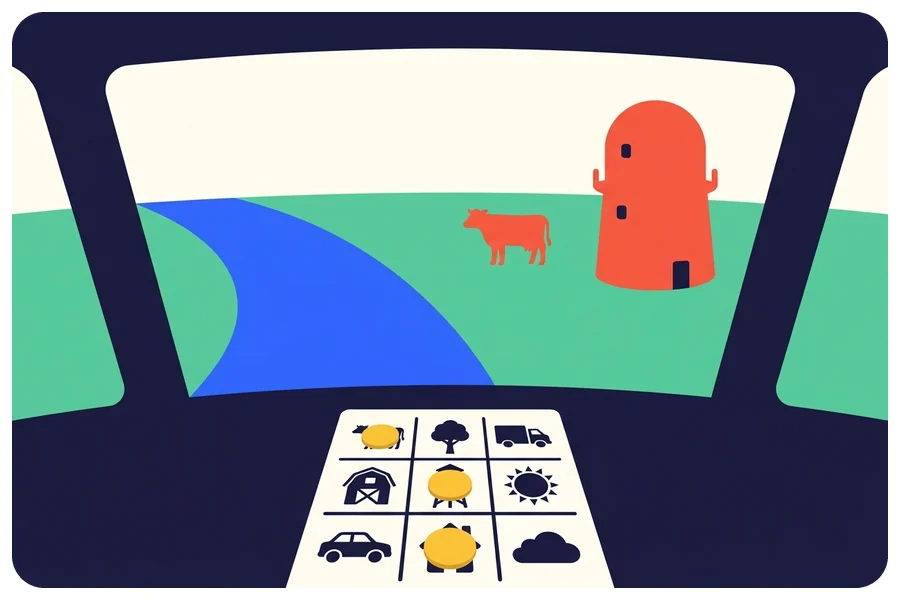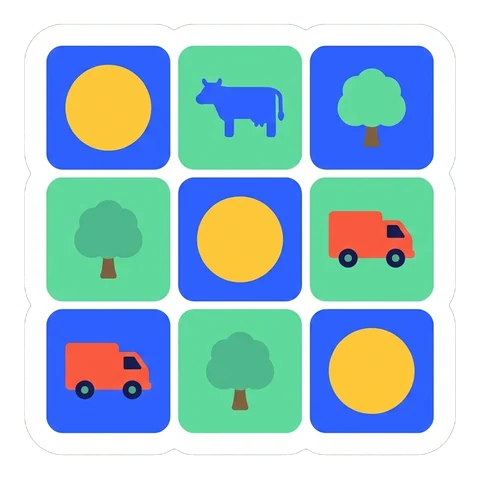
Road trip bingo is a spotting game played on bingo cards: every square shows something you might see from the car, like a cow, a water tower or a motorcycle, and you mark it when you spot it. The first player to complete a row, column or diagonal wins. You can play it on a phone or on printed cards, and it works from preschool up.
Make free bingo cards for your car: every player gets a different card, in pictures for kids who can’t read yet or words for everyone else.
The rules
- Give every player a different card. Identical cards mean every round ends in a tie.
- When you see something on your card, call it out so others can confirm, then mark it.
- One sighting counts for everyone who has it. If your sister spots the tractor and you both have a tractor square, you both mark it.
- The first full line (across, down or diagonal) wins. The free center square counts on 5x5 cards.
The “one sighting counts for everyone” rule matters more than it looks. Without it, kids start calling things they didn’t see to beat a sibling, and the game turns into an argument.
Choosing a card size
- 3x3 for ages 3 to 5. Nine big pictures, a line in 10 to 20 minutes.
- 4x4 for ages 5 to 8. Sixteen squares, about 30 minutes to a line.
- 5x5 for 8 and up. Twenty-five squares with a few rare items; a line takes 30 to 60 minutes, and a full card can last a whole day.
Versions by age
Toddlers (3–4)
Picture cards, 3x3, and a parent reads each item aloud when it passes: “There’s a cow! Do you have a cow?” Toddlers don’t need to win; they need to find things. Let them keep marking after someone calls bingo.
Kids (5–8)
Word or picture cards at 4x4. Play several short games instead of one long one. A new card every 30 minutes keeps attention better than a single blackout race.
Tweens and teens
5x5 with blackout rules: the winner is the first to mark every square. Add a “steal” rule: if you spot an item before its owner, you call “steal” and they can’t mark it for five minutes.
Adults
Adults play bingo to referee, but a 5x5 card with rarer items holds their attention on a long highway day: a covered bridge, a car with a canoe on top, a state welcome sign. Set a prize for the first line, like picking the next stop’s snack.
Phone or paper
On a phone, cards are free, can’t get lost under a seat, and a new card takes one tap. On paper, a kid has something to hold and no screen time. Printed cards go in a sheet protector on a clipboard with a dry-erase marker, so one printout lasts the whole trip. Skip crayons: they melt on a sunny dashboard.
Driver-safe version
Scanning the roadside for a list of items is a passenger job. The driver doesn’t hold a card. The driver’s role is announcer: when they notice something big coming up (a bridge, a train), they call “bridge ahead!” and the back seat gets ready. That’s plenty of involvement.
When it gets boring
Bingo slows down on repetitive highway, where the same 10 things repeat for an hour.
Generate a new card with a different theme, or switch to “four corners,” where only the corner squares count. For a game with no card at all, the license plate game and I Spy run on what you see out the window.