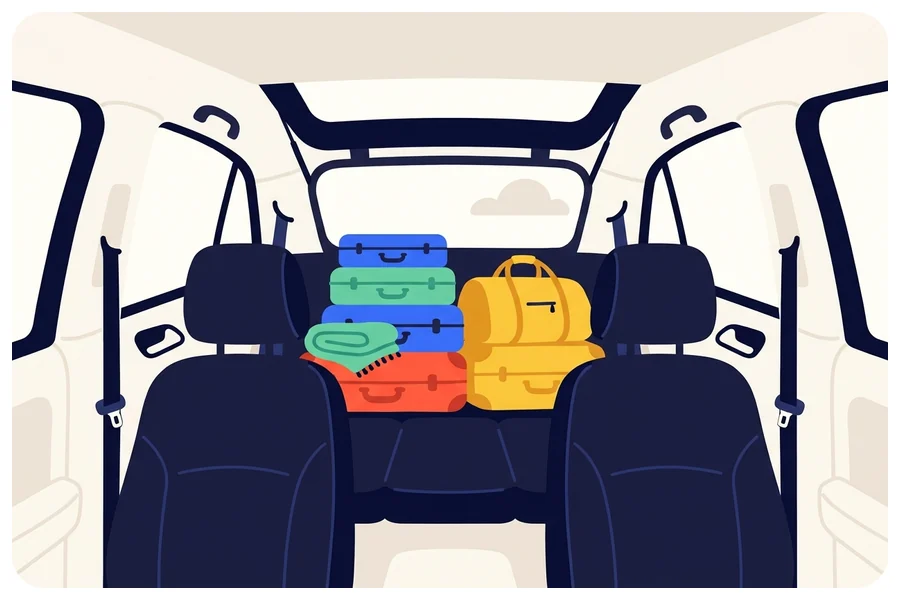
I packed my suitcase is a memory chain: the first player says “I packed my suitcase and in it I put…” and names an item, and each player after repeats the whole list in order before adding one new thing. Forget an item or mix up the order and you’re out, so the list gets harder every turn.
It needs no supplies and no looking out the window, so it works at night, in traffic, and with the driver playing.
Rules
- Pick a starting player. They say the opening line and one item: “I packed my suitcase and in it I put a flashlight.”
- The next player repeats everything so far, in order, then adds their own: “…a flashlight and a pineapple.”
- Keep going around the car. Seat order matters, so set it before you begin: driver, front passenger, then back seat left to right.
- A wrong or missing item costs a life. Each player has three. When you’re down to zero, you become the checker.
- The last player with lives left wins.
Three lives, and a checker
In the classic game one slip puts you out. On a long drive that means the four-year-old is out on turn two and spends the next fifteen minutes bored. Three lives keeps everyone in far longer.
The first player who’s out becomes the checker. Their job is to type each item into a phone note as it’s added, so they can rule on disputes like “did Dad say pineapple or pineapples?” This matters in a car more than at a table, because nobody can see anyone’s face to read whether they’re bluffing. A checker who was holding the list also tends to stay interested until the end.
Variants
Alphabet suitcase
Items go in A-to-Z order: an anchor, a bike, a crayon. The letter acts as a hint, so players get further. A car of kids aged 7 and up can often get well past M before the list collapses.
Destination suitcase
Everything has to fit where you’re going. Driving to the beach? Sunscreen, a shovel, a crab. To Grandma’s? Slippers, a photo album. Themed lists are easier to remember because each item connects to a picture.
Silly suitcase
Items must be things that could never fit in a suitcase: a giraffe, the Eiffel Tower, a swimming pool full of pudding. Absurd images stick, and the kids who laugh hardest usually remember best.
Actions only
“I went to the park and I… jumped, sneezed, hugged a tree.” Verbs are harder to hold than nouns and make a good round for adults.
By age
4 to 6
Play as a team against the list, and allow hand hints. An older sibling can mime the item (“flap, flap” for a bird) when the little one gets stuck. Four items is a good round.
7 to 11
Alphabet suitcase with three lives. This is the age where kids beat their parents, so let them.
Teens and adults
Add a rule: every item needs an adjective, and the adjective has to be repeated too. “A purple flashlight, a sad pineapple.” Twelve items with adjectives is hard.
Tips for a long drive
- Play it early in the day. Tired kids forget item three and melt down.
- Start a fresh list after every 15 items. A 30-item list takes too long for one turn and loses the little ones.
- Picture each item somewhere in the car as it’s added: the flashlight on the dashboard, the pineapple on the dog. It’s the same trick memory champions use, and it makes long lists far easier to hold.
When it stalls
If the lists keep dying at five items, the players are tired, not bad at it.
Switch to a game that asks less of memory, like word association, which keeps the talking-in-turns rhythm without the list. Or try Categories, where each turn only needs one fresh answer.